Climate Change Keeps Allergy Sufferers Sneezing
-

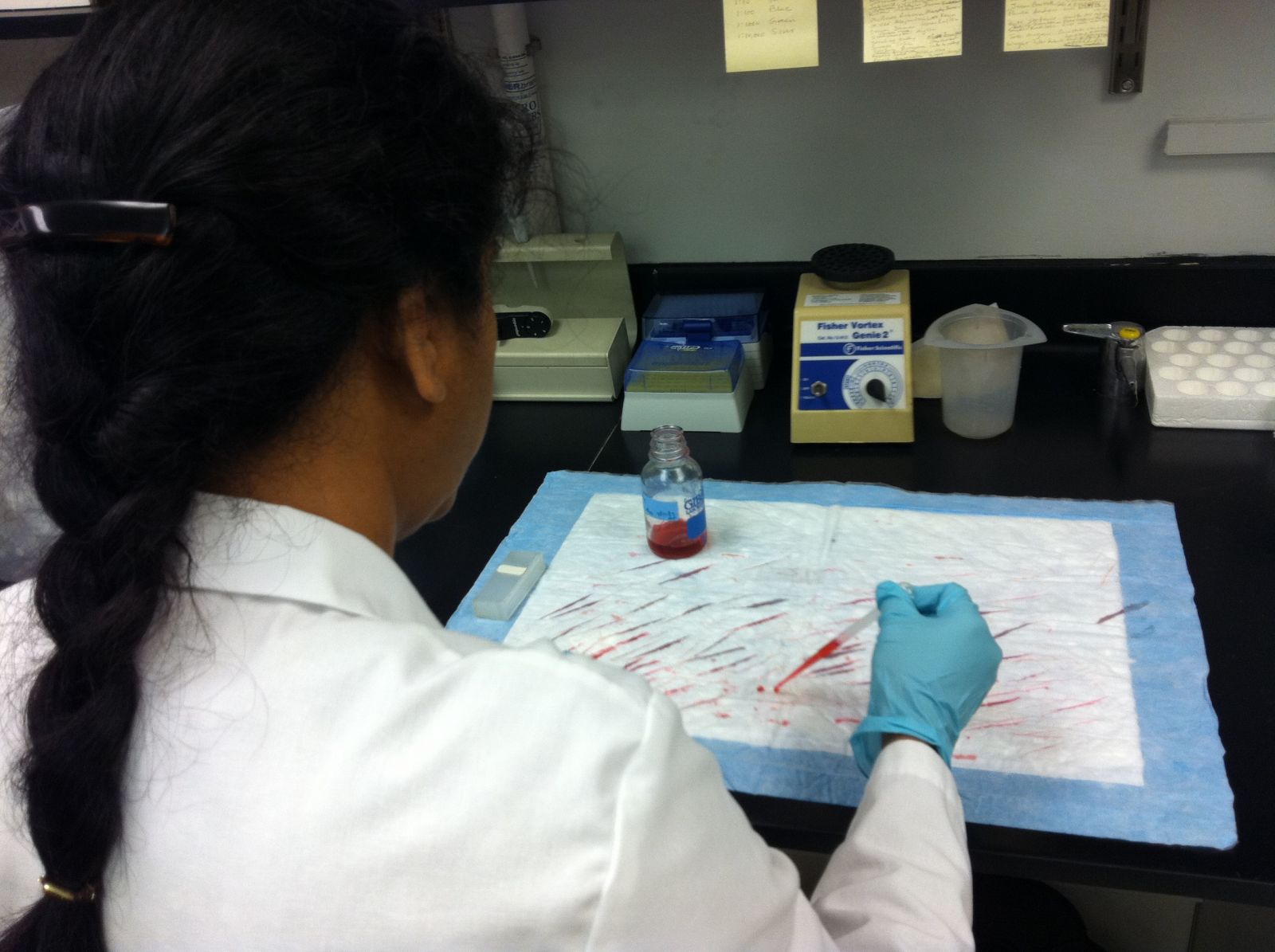
Asha Patel, an immunology researcher, uses a Burkard Spore Trap to collect pollen on the roof of Allegheny General Hospital in Pittsburgh. Photo: Julie Grant.
July 18, 2014
If even hearing the word “ragweed” makes your eyes water, you might be one the nearly 45 million Americans with seasonal allergies. And allergists say the number of people with sensitivities to ragweed and other plants is growing. Our series on the local impacts of climate change continues, with a look at how higher temperatures are fueling the rise in allergies and asthma.
Jenny Fischer has been taking over-the-counter medication for allergies for a long time. Without it, she suffers cold-like symptoms: a runny nose, sneezing and congestion. An allergy pill usually made it better. But a couple of years ago, things started to get worse.
“I’d be out at 5:30 in the morning walking my dog, and it would just be huffing and puffing. And, you know, I couldn’t catch my breath.”
Fischer was diagnosed with asthma.
“When you’re generally healthy, you take your breathing for granted. And experiencing the symptoms and not being able to catch your breath, it’s scary.”
Now in her 50s, Fischer needs to use an inhaler for asthma.
Allergists around the country are reporting more patients, with worsening allergies, to a greater number of plants. Hot weather and high plant pollen in summer trigger the symptoms. Fischer’s doctor, David Skoner, at Pittsburgh’s Allegheny General Hospital says these days he spends his lunch hour filling out new prescriptions.
“The number of patients calling in for allergies has just skyrocketed.”
There are many theories as to why this is happening around the nation. Some blame air pollution or an overuse of antibiotics. But the American College of Allergy, Asthma and Immunology says a top reason is climate change. Higher temperatures and carbon dioxide levels are affecting plants, and that’s leading to more allergies.
Determining the allergen density
Immunologist Asha Patel walks up to the roof of Allegheny General Hospital in Pittsburgh every morning to take pollen counts. She uses a machine called a spore trap. It looks kind of like a small weather vane. And Patel says it pulls in air like a large nose.“There’s a suction created. So it draws the air through this opening right here, and the sample is collected inside.”
Patel takes a glass microscope slide out of the spore trap. It’s the one she put in yesterday. And it’s covered with speckles. She takes it down to the lab and dots on pink dye. Under the microscope, she watches as a perfect circle emerges. She says it’s the pollen from a common weed.
 Ragweed season lasting longer
“Here’s the English plantain, it’s one of the weeds.”
Researchers do this kind of pollen collection all over the country. After 10 years of collecting samples every day, Patel knows what to expect. Tree pollen season usually shows up first, then plantain and grasses. In August, she’ll start seeing ragweed pollen.
But as winters get warmer, the pollen seasons are starting earlier.
Dr. Leonard Bielory of Rutgers University has been researching the connection between rising temperatures, pollen levels, and the throngs showing up at his office with watery eyes, stuffy noses and trouble breathing.
“I saw a hidden signal in the pollen count changing over time. And I started correlating that we’re seeing patients earlier and the volume seems to be increasing.”
In a study published by the National Academy of Sciences, Bielory and other researchers looked at a common allergen, ragweed, in the Midwest and Canada.
The further north they looked, the more dramatic the increase in the length of pollen season. 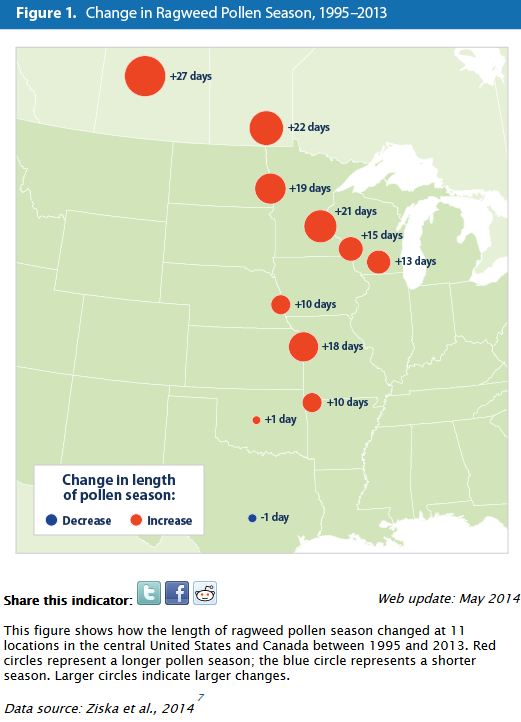 In Canada, they found the ragweed season was almost a month longer in 2009 than in 1995.
Bielory says there’s been an increase in our region, but not quite that striking.
“The ragweed has started earlier in Pennsylvania by about 3-4-5 days over the past 20 years. So it’s about a day for every five years of climate effects.”
Plants producing more allergenic proteins
And it’s not just that the ragweed pollen season is getting longer. Researchers looking at the impacts of climate change also find that as carbon dioxide levels rise, the pollen is becoming more severe. Lewis Ziska is a researcher with the U.S. Department of Agriculture. He says they were surprised by the effect of CO2 levels on ragweed production.
“Just changing the CO2 from the early part of the 20th century to the latter part of the 20th century, for example, doubles the production of pollen from a single plant. And there was some indication that it was a more allergenic pollen. That is, it was producing more of the proteins that people were allergic to.”
That could mean more people suffering from serious allergies and asthma. Researcher Leonard Bielory says the worsening pollen is especially dangerous for children who have respiratory problems—because it adds to the environmental problems they face.
“And you will cause an inflammatory mix, or what I call the witches brew, where we have the temperature, ozone and pollen all mixed together, you will cause an incredible inflammatory response of the eyes, nose, and therefore in those who are more prone to it, the lungs as well, leading to more asthma admissions.”
Bielory says keeping watch of daily pollen counts can help. He says on high pollen days, people with respiratory problems can take over-the-counter medication preventatively, so nuisances, like itchy eyes and runny noses, don’t turn into dangerous asthma.
Ragweed map from U.S. EPA website.
Ragweed photo: Geoff Gallice via Flickr.
This episode is part of a series entitled
Climate Chronicles
Stories of Climate Change from Pennsylvania

Donate to The Allegheny Front
Help us continue delivering quality environmental radio by supporting us with a donation.