ICYMI: 4 Shale Stories on Transparency and More
-
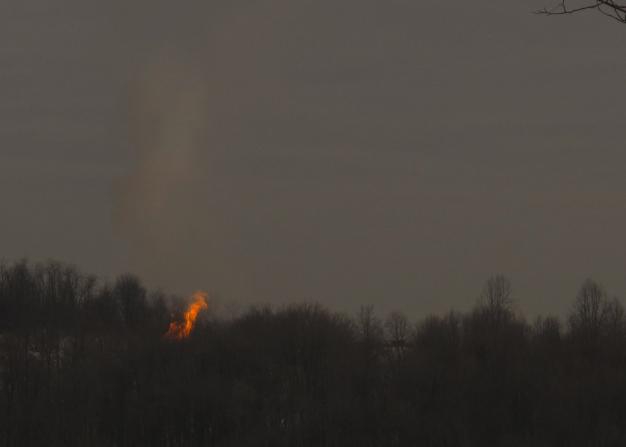
The family of Ian McKee, a worker who was killed in a February natural gas well explosion in Greene County, is suing Chevron Appalachia. Photo: Katie Colaneri, StateImpact Pennsylvania
August 8, 2014
The Public Accountability Initiative (PAI) watchdog group is again calling out the Center for Sustainable Shale Development for “greenwashing,” saying it’s growing more closely tied to the gas industry.
When launched in March 2013, the Center for Sustainable Shale Development (CSSD) billed itself as a collaboration between industry and environmental groups intended to establish voluntary rules for good environmental practices.
Last year, a PAI report lambasted the Center in part because its head, also then-head of the Heinz Endowments, Bobby Vagt, held investments in oil and gas. Heinz was at the time a major funder of the Center. After that publicity, Heinz withdrew its financial support, and Vagt stepped down from the Endowments. Longtime Endowments employee Caren Glotfelty also was ousted in the fallout. She was a liaison for beneficiaries of the Endowments’ Environment Program funding (including The Allegheny Front).
In PAI’s new report, “Anatomy of an Industry Front Group,” it cites the following as complaints:
- “Three of CSSD’s founding sponsors have ended their involvement with the group, replaced by the family foundation of West Virginia’s ‘king of the wildcatters.’ Beginning in October 2013, the Heinz Endowments, the William Penn Foundation, and Citizens for Pennsylvania’s Future (PennFuture) have all pulled out of CSSD, though PennFuture still provides input to the group at its discretion. After the Heinz Endowments and the William Penn Foundation ended their philanthropic sponsorship, the Claude Worthington Benedum Foundation, endowed by the oil and gas driller Michael Late Benedum, joined CSSD. The Claude Worthington Benedum Foundation also maintains ties to the drilling industry through its board of trustees.”
- “CSSD has hired an attorney from an oil and gas industry firm as its executive director... Before joining CSSD, (Susan Packard) LeGros was an environmental attorney at Stevens & Lee, and the contact named for the firm’s oil and gas practice.”
- “CSSD has hired an energy industry public relations professional to manage its communications:… O’Brien (Communications) lists the energy industry first among the industries it serves, providing ‘communications planning, counsel and support to companies actively engaged in developing one of the largest natural gas fields in North America –the Marcellus Shale.’”
PAI’s report concludes that the Center for Sustainable Shale Development bears “the hallmarks of a public relations campaign meant to ‘greenwash’ gas drilling.”
PennFuture didn't go nearly as far in explaining why it distanced itself from CSSD. Here's PennFuture's response, e-mailed from Director of Outreach Andrew Sharp to The Allegheny Front: "PennFuture recognizes the Center's collaborative spirit in bringing environmental, public health, and private sector stakeholders to the table. We remain willing to provide input on issues that we believe are important to protecting Pennsylvania's land, air, and water. We do not participate in setting CSSD policy, nor do we have a voting role—and have not for some time. Our foremost priority remains tough and aggressive regulation of the natural gas industry, and strict enforcement of the same. We will continue to work closely with members of the environmental community, regulatory agencies, and the private sector toward that end."
Transparency about fracking chemicals remains elusive
A new report by StateImpact Pennsylvania's Katie Colaneri examines the website FracFocus.org. It was built to give the public answers to a burning question about the shale boom: what exactly were companies pumping down tens of thousands of wells to release oil and gas?
Today, FracFocus has records for more than 77,000 wells. Pennsylvania is one of 14 states requiring operators to use the website as part of their chemical disclosure laws, according to the U.S. Department of Energy.
PPL Proposes new transmission line
PPL Electric Utilities is looking to build a new multi-billion dollar transmission line to keep up with natural gas production in the Marcellus Shale and the changing landscape of power generation, reports StateImpact Pennsylvania's Marie Cusick.
If approved by regulators, the high-voltage power line is still a decade away but PPL has started planning.
The transmission line would start in Western Pennsylvania and run 725 miles through the state’s Northern Tier, into New Jersey and New York, as well as southward into Maryland.
State faults Chevron, self, after fatal explosion
The Department of Environmental Protection says Chevron was “too guarded” in its communication with state regulators and the media, and did not provide adequate information after a fatal well fire in southwest Pennsylvania, StateImpact's Colaneri also reported this week.
The DEP admits it is also to blame for the poor communication and that the agency did not immediately assert its authority following the incident in February.
A second report by the department’s Bureau of Investigations faults Chevron’s site managers for inadequate supervision over several contractors working on the Lanco A well pad in Dunkard Township, Greene County.