Activists Bracing for Changes at Paris Climate Talks in Wake of Terrorist Attacks
-
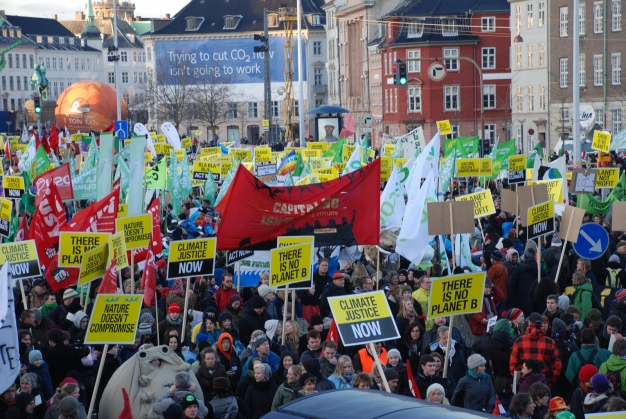
Climate activists are gearing up for the United Nations climate summit in Paris, where policy makers will try to negotiate targets for curbing greenhouse gas emissions. Talks like these draw climate activists in addition to global leaders. Pictured here, demonstrators take to the streets of Copenhagen during the Copenhagen Climate Change Conference back in 2009. Photo: Bureau of IIP via Flickr
November 27, 2015
Since January, Angela Wiley has been preparing a Sierra Club youth group of 15 students and young people to travel to Paris for the upcoming United Nations climate talks.
This will be the fourth UN climate meeting for the Pittsburgh climate activist. Wiley started going to them in 2011, at the age of 20.
“This is the year," she said. "This is like the prom for me.”
Many climate activists like Wiley see these talks as the best hope to date for a big, binding climate deal.
When she learned of the recent terrorist attacks in the French capital, her first thought was for a pair of friends in Paris. They were safe, it turned out. Her next thought was whether the attacks would affect her trip to the climate talks that she'd been planning for the last year.
"I had a pretty immediate sinking feeling that it was a point of no return for a lot of efforts that have been moving forward quite steadily for some months," Wiley says.
A lot of those efforts, like lectures, conferences, and meetups she was planning to go to, will still go on. But French offiicals have banned most public demonstrations, striking a blow to those who want to see a deal that sharply curbs carbon emissions.
Jamie Henn of the activist group 350.org says those demonstrations are important because they’re one way for climate activists to help negotiators reach a strong climate deal.
“It's really helpful to have hundreds of thousands of people in the streets to point to when you're a politician,” Henn says. "We've seen over the years the real leadership on climate change and the breakthroughs that we've had have come from the grassroots and from public organizing rather than from political leaders."
Last year, 300,000 marched in New York City during a UN climate summit. Sunday’s now-cancelled event could have rivaled that march and was to feature native people from around the world.
Dallas Goldtooth, a spokesperson for the Minnesota-based Indigenous Environmental Network, would have been in the march. He says losing public demonstrations can take some of the impact away from the climate movement during the talks.
"We lose the opportunity to get that front-page headline photo with a banner that basically describes in a very succinct way why we are there," Goldtooth says.
Goldtooth’s group is bringing canoes from native peoples from around the world to Paris. These include a birch bark canoe from Alberta, Canada and a boat from the Sarayaku people of the Ecuadorian Amazon. That canoe was crafted especially for the Paris protests.
"A month and a half ago it was literally a tree in the Amazon," Goldtooth says. "The Sarayaku Nation had a ceremony and they brought the tree down. One of the traditional artists carved out this canoe."
They were planning to paddle the canoes down a Parisian canal, but with new security measures, they may have to settle for a land-based photo-op.
Activists are also bracing for decreased mobility around Paris. Colette Pichon Battle of the Louisiana-based Gulf South Rising says activists in her group, some of whom have never traveled outside the U.S., were planning to stay in apartments in the city. But for safety reasons, they are staying in a dorm outside of Paris.
"There won’t be anybody just hopping on the train just experiencing Paris. We have to move now as a group," says Pichon Battle. That means fewer chances for her group to meet fellow activists from around the world and share their stories of why they see climate change as a threat.
Activists will still try to make an impact during the talks. Protests are planned in more than 100 countries around the world.

Reporter/Producer
Reid R. Frazier
Reid R. Frazier covers Marcellus shale and energy for The Allegheny Front.
Read more by Reid R. Frazier »Donate to The Allegheny Front
Help us continue delivering quality environmental radio by supporting us with a donation.