Land Stewardship: Mimicking Nature With Fire
One of the most labor-intensive ways to manage or "steward" certain ecosystems is with fire. The Allegheny Front's Ann Murray traveled to the Poconos in northeastern Pennsylvania to witness a controlled burn in a "fire starved" pitch pine forest.
Transcript
OPEN: Conservationists often say that buying land's the easy part of land conservation. Maintaining land over time is the hard part. One of the most labor-intensive ways to manage or "steward" certain conserved ecosystems is with fire. The Allegheny Front's Ann Murray traveled to the Poconos in northeastern Pennsylvania to witness a controlled burn in a "fire starved" pitch pine forest.
MURRAY: Todd Sampsell is standing next to a plot of charred trees and shrubs. Sampsell's the head of stewardship for the Pennsylvania chapter of The Nature Conservancy. He shakes his head and points to the fire blackened soil.
SAMPSELL: Over the past 80 to 100 years, we've really worked to suppress fire. We've lost sight of the fact that a lot of vegetation communities relied on natural fires at certain times of the year.
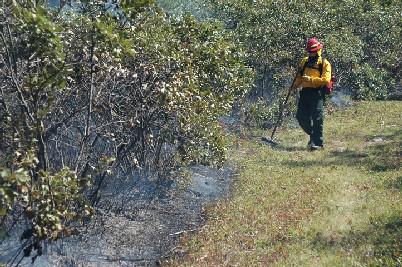
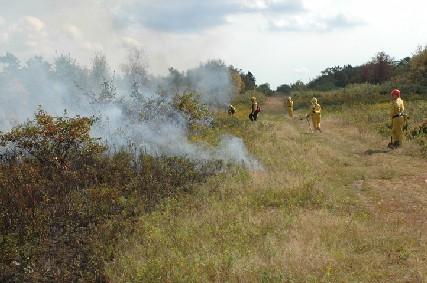
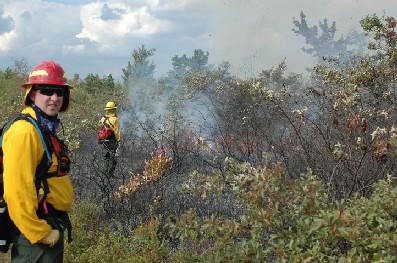
MURRAY:. Sampsell says pitch pine forests in the Pocono and Appalachian Mountains have been fragmented by suppressing natural fires A specially trained crew set this wooded area on fire in a series of "controlled burns". Today, the crew's gearing up for the last fire of the season on this property. They'll burn a seven - acre chunk of pitch pine forest in a rare vegetation system known as the barrens. As Sampsell suits up in yellow coveralls and a red fire helmet, other members of the eight - person crew position trucks and test water pumps. The Conservancy's land steward and fire specialist, Jenny Case, checks out the amount of moisture in the air. She waves or "slings" something that looks like a thermometer with a wet cotton wick on the end .
CASE: What was your wet and dry? BRIAN: 41 wet and 49 dry. JENNY: That's what we had.
CASE: We're slinging weather right now before we start the fire to get a baseline. We sling weather every hour during the burn to make sure we're not getting any shift in wind direction or speed.
MURRAY: The Nature Conservancy works with their scientists and foresters before every burn to figure out not only local weather patterns but also vegetation types and the lay of the land. To make sure all of that information reaches today's crew, the Conservancy's fire boss, Pat McElhenny, holds a pre-fire briefing. Everyone gets a map.
McELHENNY: To orient the guys who are sort of new here, between B and C, that's red maple swamp so it's really going to be wet in there. From A and B we have a mix of scrub oak and pitch pine... We'll talk a little more about crew assignments once we come around.
MURRAY: The crew walks around the edge of the wooded plot to talk about any final safety concerns. Then they break into two teams.
McELHENNY: Everybody set. Their gear. Their crew....We're going to move down, put fire on the ground and move from there.
Want to give me some fuel right in here?
MURRAY: The teams light a small test fire to gauge the behavior of the flames. Then they start at a common point along one edge of the woods and begin working away from each other. On one crew, Todd Sampsell ignites a swath of low lying shrubs with a drip torch. Jenny Case rakes away burned debris. This creates a strip of damp soil along the edge of the fire.
CASE: You build your black...your safety around the edges. The fire's not going to come through there. JENNY TO TODD: You can do it a little wider. Some zigzags. TODD: Some zigzags.
NAT SOUND: WALKING THROUGH LEAVES LIGHTING FIRE
MURRAY: Both teams continue to ignite trees and shrubs until they have the whole wooded plot ringed with fire. Flames gobble up low lying invasive plants. Most of the trees are only singed. The low intensity fire will help pitch pines spread their seeds, add nutrients to the soil and cut back on competition among plants for space and sunlight. A couple hours later, as the fire burns itself out, Todd Sampsell says this controlled burn will also cut down on the chances of high intensity wildfires.
SAMPSELL: In some of these areas that haven't had regular fire occurring at regular intervals, we see a lot of build up of vegetation and debris that essentially is a build up of fuel .And so by using prescribed fire we not only reduce those fuel loads, you won't get out of control wild fires coming through the area.
MURRAY: The conservancy might have to burn this site several more times in the next few years to get healthier plant populations back. Once that happens, they'll ignite low intensity fires here every 10 or 15 years. That will keep these fire dependent plants healthy and revive the habitat for the rare butterflies, moths and migrating songbirds that live in these woods. All in all, it's a really expensive and time- consuming process. But Todd Sampsell believes this kind of active land management makes sense for his conservancy.
SAMPSELL: I think as land conservation gets more and more difficult because land prices are going up..we have to focus on maximizing the condition of the land that we do have preserved. We can't invest a significant amount of money in land protection and not ensure that land is taken care of the way it needs to be.
MURRAY: So far, the Nature Conservancy has had controlled fires on about 600 acres of their lands in Pennsylvania. Over the next couple years, they plan to help the state and smaller conservancies bring back other "fire-starved" habitats. For The Allegheny Front, this is Ann Murray.

Contributor
Ann Murray
Ann Murray reports on a wide range of environmental issues for The Allegheny Front.
Read more by Ann Murray »Donate to The Allegheny Front
Help us continue delivering quality environmental radio by supporting us with a donation.